A lobster cracker is an unusual object to associate with a sneaker store. At Concepts, it makes sense. The accessories surrounding its 2008 Nike SB collaboration borrowed from a seafood meal, turning a shoe release into an encounter with a recognizable New England ritual. The box and its contents belonged to the same idea. The shop selling them helped give that idea a setting.
That relationship between an object, its presentation and its audience is central to Concepts. Its history follows the development of a retailer that also acts as a creative producer. A regional reference can become a design brief; a collaboration can generate a campaign; the store can become the place where those elements meet. The result depends on people who know how to translate an ordinary detail into something worth a second look.
A shop inside another shop
Tarek Hassan founded Concepts in Cambridge, Massachusetts, in 1996. It began inside the Tannery, combining sneakers with skate-related merchandise, outerwear and denim. The arrangement matters: Concepts developed a distinct selection within an existing retail environment before its identity had a freestanding architectural expression.
An interview published by Sneaker Freaker in 2008 captured a later transition. Concepts had recently opened its own nearby location, with a lower-level membership lounge. Frank the Butcher described a customer base shaped partly by surrounding universities, mixing knowledgeable shoppers with people encountering unfamiliar labels. The shop needed to be legible to both.
That mix helps explain the usefulness of a strong story. Technical vocabulary can mark the boundary of an enthusiast community. A reference to a familiar meal, place or person gives someone else an entry point. It does not remove the pleasure of specialist knowledge; it adds another way to understand why a retailer has brought particular things together.
The people behind the lobster
Nike SB's archive dates the original red Lobster to 2008. Speckled surfaces, a bib-like pattern and an elastic band around the toe carried the seafood reference into the shoe itself. These were concrete visual cues, understandable without a long explanation of footwear technology.
The idea did not arrive fully formed or win immediate agreement. In Sneaker News's oral history, Deon Point recalled initial doubts about Rob Heppler's proposal, followed by a change of mind after its development. Point and Frank the Butcher subsequently worked with Boston design studio Pilot on the Concepts Fishing Company campaign.
That account is useful because it restores the collaborative labor behind a famous retail project. The finished object can make an idea look inevitable. The recollections show discussion, revision and a separate effort to make its presentation coherent. A store's authorship can be shared among buyers, designers, writers and outside specialists rather than concentrated in one name.
Contemporary launch coverage described seafood-themed packaging and a celebration catered by Legal Sea Foods. A later blue edition followed in 2009; Nike's archive also records purple in 2018 and orange in 2022. The recurring theme gave Concepts a recognizable language without requiring every project to start from an unfamiliar premise.
Other local references offered different material. The 2011 New Balance Kennedy collaboration drew on John F. Kennedy and a nautical New England vocabulary. For the retailer's history, the important connection is the approach: a place could supply stories as well as customers. Those stories were selected and staged, rather than serving as a complete portrait of the region.
Giving the narrative a physical setting
In 2017, Concepts and adidas opened The Sanctuary at 73 Newbury Street. Sid Lee and Sid Lee Architecture designed the basement space with reflective surfaces and glass arches; artist Jordan Sodenberg Mills contributed interactive mirror boxes. Display became an active part of how merchandise could be seen.
The project extended a question already present in the Lobster packaging. How much can the surroundings change the reading of an object? In a box, the answer involved accessories and printed material. In a room, it involved light, reflections and the route between displays. Both approaches ask the shopper to notice presentation as part of the work.
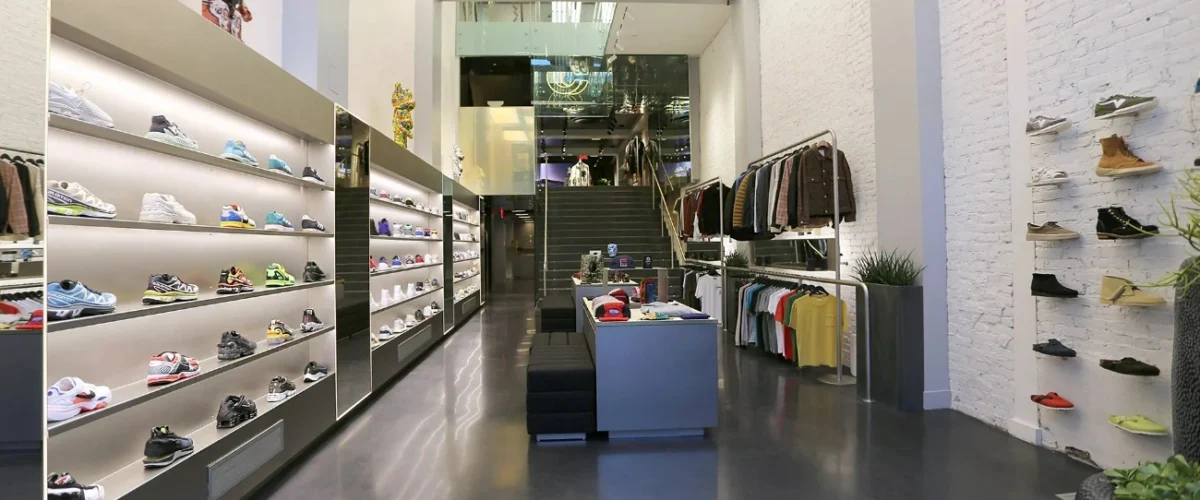
A larger expression followed at a different Newbury Street address. Concepts opened its three-level flagship at number 18 on October 24, 2020. Its opening announcement described a central staircase informed by the Greek theater, gallery-like areas, a women's luxury space called VRSNL and a café.
Sid Lee Architecture's account explains that the building's length encouraged a sequence of environments. It also records the pandemic context: appointments and spacious circulation helped accommodate the conditions of opening in 2020. The aspiration to gather people had to coexist with practical limits on gathering.
This is an important part of the store's cultural story. Retail theater still takes place in a building, under the pressures of a particular moment. Concepts' progression from a section of the Tannery to these deliberately composed environments shows how a shop can develop a voice through selection, collaboration and space. The lobster is its most memorable shorthand, but the larger subject is the work of giving an idea a public setting.
An interview with Concepts at the 2008 Lobster launch
The people behind the Lobster campaign
Concepts announces its 18 Newbury Street flagship
Sid Lee Architecture on the Boston flagship
Frequently asked questions
Who founded Concepts and where did it start?
Tarek Hassan founded Concepts in Cambridge, Massachusetts, in 1996. It began inside the Tannery, combining sneakers with skate-related merchandise, outerwear and denim.
When did the first Concepts Lobster Dunk release?
The original Concepts Nike SB Lobster collaboration was released in 2008, with accessories inspired by a New England seafood meal.
Who helped develop the Concepts Lobster idea?
In Sneaker News’s oral history, Deon Point recalled initial doubts about Rob Heppler’s proposal, followed by a change of mind after its development. Point and Frank the Butcher subsequently worked with Boston design studio Pilot on the Concepts Fishing Company campaign.
What inspired Concepts’ New Balance Kennedy collaboration?
The 2011 New Balance Kennedy collaboration drew on John F. Kennedy and a nautical New England vocabulary.
When did Concepts open its 18 Newbury Street flagship?
Concepts opened its three-level flagship at number 18 on October 24, 2020. Its opening announcement described a central staircase informed by the Greek theater, gallery-like areas, a women’s luxury space called VRSNL and a café.
Related store histories
Bodega
Extra Butter