The ASICS GEL-KAYANO 14 and GEL-1130 speak a language that retro-running fans recognize immediately: mesh, curved layers, side stripes and details that make the upper look like a small engineering project. The difficult part comes when both appeal and you want to know whether the price gap buys something you will appreciate.
Start with the design, then let the fit answer the rest. The GEL-KAYANO 14 has a particular appeal if you want to explore the Kayano family’s visual construction. The GEL-1130 offers another interpretation of the same era with its own identity. If both fit well, the actual price and your favorite colorway can decide without one needing to win every category.
These are SportStyle sneakers
ASICS describes the 2020 GEL-KAYANO 14 revival as a lifestyle adaptation of its 2008 running shoe, with the upper and fit updated for everyday urban use. That is the context of this guide. Other numbered GEL-KAYANO performance-running models belong in a separate evaluation.
A review of a running Kayano therefore does not automatically answer whether the Kayano 14 is the right addition to your sneaker rotation. Likewise, the GEL-1130’s sports background is not a present-day training recommendation.
If your interest extends to current racing-shoe design, our guide to carbon plates in shoes explores a different set of design and use questions. An athletic appearance alone cannot settle which category you need.
The exact references
The examples here are the GEL-KAYANO 14 Black/Pure Silver 1201A019-006 and GEL-1130 Black/Pure Silver 1201A906-001. The Japanese 1130 specification lists synthetic leather, synthetic textile and a rubber outsole. Other editions need their own material check.
Dark reference colorways help keep the focus on the construction, but cream, white, silver and brighter options may be what you actually want. Color contrast changes how strongly the panels show. Comparing an almost monochrome shoe with a highly contrasted one can exaggerate a model difference.
Collaborations, suede treatments and variants such as NS or CV are outside the direct comparison. The words GEL-1130 in a listing are not enough to assume the same upper. Generic leather wording on a Kayano page is also not a reason to label every panel of every edition natural leather.
Why the family resemblance is real
The connection is documented in the archive. ASICS’ GEL-1130 SportStyle announcement links it to the ninth GEL-1000 generation and relates its upper construction to the GEL-KAYANO 14. Their shared visual language is more than a similarity created by both becoming popular casual choices.
Try comparing them by following the lines. Look at where the toe overlay meets the side, how the stripes cross the mesh and how the upper finishes at the heel. One appeal of a retro runner is seeing the construction become part of the design. Layered pieces give your eye several routes around the shoe.
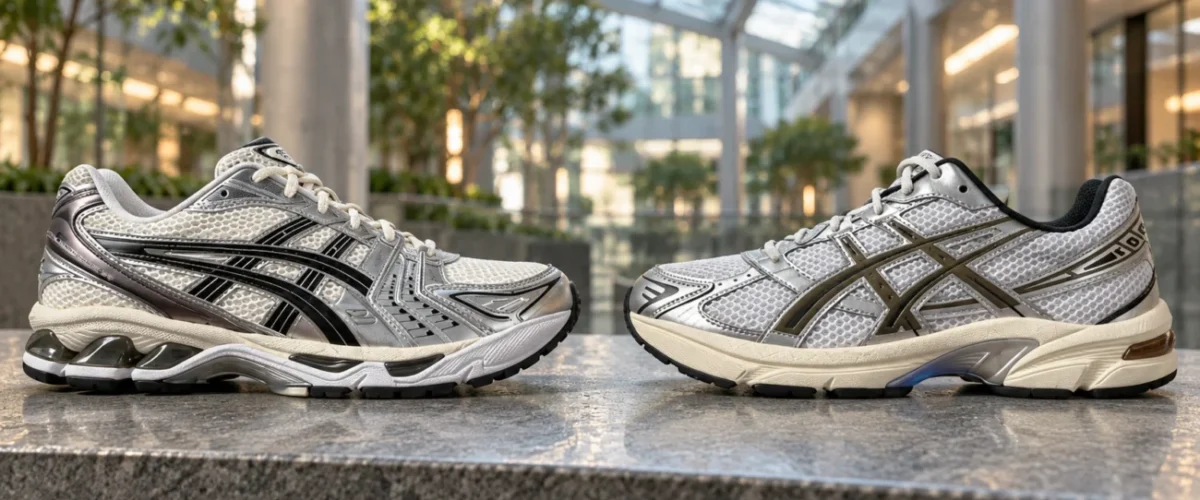
The official photos of these exact pairs reveal an especially clear difference along the sole. The reference Kayano 14 has strongly sculpted silver sections at the forefoot and heel. The reference 1130 has a more continuous dark sidewall with a smaller heel detail. Above that, the 1130 leaves a more open mesh area between the side overlays, while the Kayano has more overlay detail around the front. That visual comparison helps explain their different presence without pretending a photograph measures cushioning.
The Kayano 14 can read as the more elaborate design, particularly when contrasting colors separate its components. A tonal 1130 can look quieter. Those are styling impressions, not measurements of quality. A strongly contrasted 1130 can easily attract more attention than an almost all-black Kayano.
ASICS also identifies the 14 as the first design in the lineage by someone other than Toshikazu Kayano. For an enthusiast interested in how a series evolves, that handover adds context. It does not create an obligation to prefer the shoe if another pair fits your taste better.
What GEL and TRUSSTIC tell you
The official Kayano 14 reference lists GEL cushioning and TRUSSTIC. In its GEL-1130 technical description, ASICS also lists heel GEL and TRUSSTIC. Shared feature names do not mean every part of the two constructions is identical.
GEL identifies a cushioning solution; TRUSSTIC identifies a structural support solution. They help explain the design, but neither provides a personalized comfort score. A cushioning element being more visually prominent is not proof that you will prefer it on a walk.
During a try-on, separate three questions. Do you like the underfoot feel? Does the upper accommodate your foot without pressure? Does the shoe stay in place without excessively tight laces? A positive answer to only the first question does not resolve the other two.
Do not turn the word stability into a promise to correct a foot issue or resolve pain. This is an everyday sneaker comparison. An individual requirement cannot be decided by a model family’s reputation.
Sizing: keep running advice in its context
The ASICS size guide separates measurement instructions from running-specific recommendations. Advice for a running shoe should not automatically become an instruction to size up every SportStyle sneaker.
Measure both feet and check the chart appropriate to the actual listing. In the US, make sure you are reading men’s, women’s or the displayed unisex size correctly. For imports, identify the scale before comparing numbers from different stores.
Use the same socks and adjust the laces in sections before walking in each complete pair. Pay attention to pressure where the overlays meet the sides of your feet and to heel movement. Give those sensations as much attention as the cushioning.
If the sides feel tight but there is already spare length, going up can introduce a different problem. If the heel slips, tightening the instep until it becomes uncomfortable is not a good solution. Our sizing and fit guide helps separate those signals.
Owner reports are useful for identifying things to check. They are less reliable as automatic size instructions, especially when they describe another collaboration, material or size category. “True to size” is too short a phrase to capture all of those differences.
Choosing for your wardrobe and rotation
You want the shoe to be the focal point
Look at versions that reveal the lines you like. Silver, white and dark contrasts can make the Kayano 14’s construction more visible, while simple clothing gives those details room. Check the heel and side with pants you already wear, rather than judging only in try-on shorts.
If the Kayano’s particular architecture is the attraction, paying more for that preference can make sense. A collection purchase does not always need a performance justification. It does need a reason that matters to you.
You want an easy-to-repeat retro runner
A low-contrast GEL-1130 may fit that role visually. Compare a similarly restrained Kayano too, because the model name alone does not decide versatility. Think through three outfits you already own and see which pair belongs most naturally in them.
One practical trick is to look at a small version of the product photo after studying the close-ups. At a distance you see the overall shape and color balance; close up, you see the panels. Liking both views helps avoid a purchase based only on one attractive detail.
You already own one of them
The second can add a different color, upper design or relationship with your clothes. Decide whether that is what you want. Buying the Kayano as an automatic upgrade from the 1130 can create a comfort expectation that your actual try-on does not support.
If you want to broaden the look of your rotation more substantially, the New Balance 2002R vs 1906R comparison explores suede-led and more overtly technical uppers. It opens a different conversation alongside this ASICS pairing.
Is the Kayano 14 worth paying more for?
Work with real offers in your size. There is no fixed price gap across countries, colors and sellers. A sale can bring the two close together; demand for a particular edition can widen the difference considerably.
If your preferred Kayano costs more, identify the personal reason to pay: its specific design, colorway, finish or a better fit that you have confirmed. If you like both equally and the 1130 fits well, saving the money is a reasonable choice. A cheaper pair with uncertain sizing and difficult returns is less convincing.
For an everyday purchase, also consider which pair you will happily wear. A shoe you protect so carefully that it rarely leaves the box serves a different purpose from a regular favorite. Either can belong in a collection, provided it matches the intention behind the purchase.
Materials and maintenance
Layered uppers have material junctions that deserve gentle, localized cleaning. ASICS’ maintenance guidance advises against simply putting shoes in a washing machine and recommends careful cleaning and drying without direct heat. Choose products for the actual material and finish.
If machine washing seems like a convenient shortcut, read how to decide whether sneakers can go in the washer. Mesh is not automatic permission to soak the complete shoe, and metallic-looking finishes warrant a discreet test before cleaning.
Overlays are not a waterproof specification, either. Look for an explicit claim on the exact version if rain is a key concern. For ordinary care, untie the laces before removing the shoes, avoid crushing the heel and let the pair dry fully before storage.
The strongest tiebreaker is liking the whole shoe: design, color, fit and the way you plan to use it. The Kayano 14 has archive details worth appreciating; the 1130 has its own reasons to belong in a rotation. Explore more in the 90sneakers buying guide.