The Chuck 70 is worth a closer look if the details are the reason you love Converse: substantial canvas, cream-colored rubber with a glossy finish and a more structured presentation of the familiar shape. The Chuck Taylor All Star makes more sense if you prefer the simpler expression of that design and do not particularly want the vintage finish. The 70 adds specific construction and styling details; it does not automatically make the classic the wrong choice.
For a fair comparison, this guide uses black canvas high-tops: the standard Chuck Taylor All Star listed by Nike as M9160-000 and the Chuck 70 Canvas 162050C. Leather versions, platforms, Chuck 70 Plus and other variations need their own comparison. There is also an important correction to older buying advice: the current official listing for the standard reference already specifies OrthoLite cushioning.
Are Chuck Taylor, All Star and Chuck 70 the same thing?
“Converse” is the brand; “Chuck Taylor” appears across a broader family. For this purchase, the names to separate are Chuck Taylor All Star and Chuck 70. A listing that says only “classic Converse” does not give enough information to know which you are buying.
Compare the same height and material first. A canvas high-top beside a leather low-top introduces differences that have nothing to do with the standard-versus-70 question. On a high-top, you also see more upper material and the ankle patch, so the finishing differences become a more obvious part of the look.
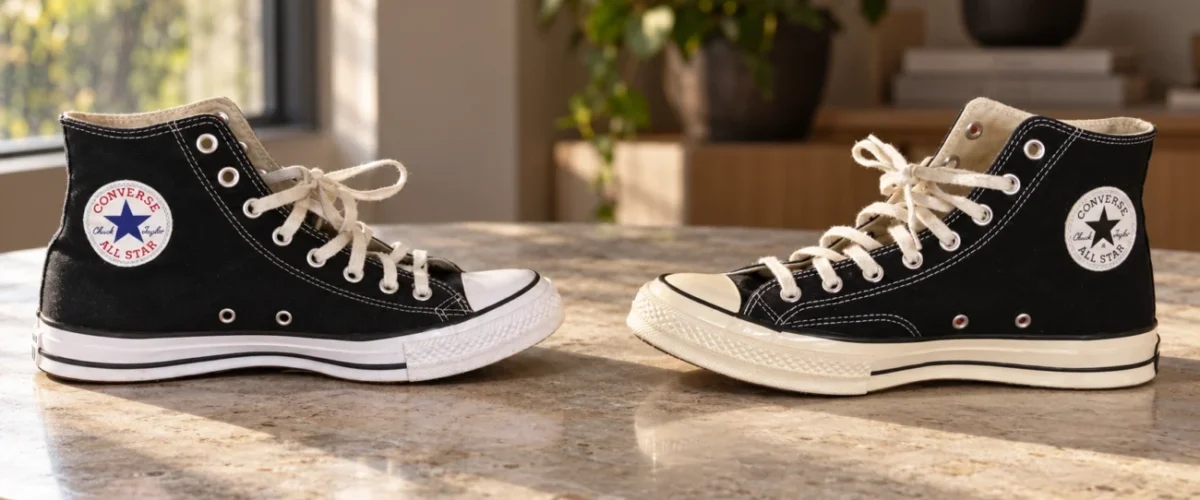
The M9160-000 All Star listing identifies canvas and an OrthoLite insole. The 162050C Chuck 70 listing specifies heavyweight canvas, OrthoLite, varnished off-white rubber, thicker laces and a leather ankle patch. Those named features are a better basis for the decision than the word “premium” alone.
The small details are the point of the Chuck 70
Look first at the rubber. The 70’s cream tone and sheen change the shoe even before you notice the upper. If you like the appearance of archive-inspired sneakers, that warmer finish may be the entire reason to choose it. If you want a crisp, straightforward black-and-white contrast, you may prefer the regular All Star.
The cream color is intentional on this reference. It is not, by itself, evidence that a new pair has yellowed in storage. That matters when comparing store photographs, where white balance can make one shoe look much warmer or cooler. Look at several images, preferably from the same seller, before deciding that a color is wrong.
Then look at the strip of rubber around the upper, often called the foxing. Converse’s Chuck 70 explanation describes taller foxing and a more substantial canvas construction than the classic. The effect is a shoe with a more defined outline, especially around the toe. It is a visible design distinction, not a reason to invent a precise height increase for the wearer.
The standard All Star has its own appeal in that comparison. Its less elaborate presentation can feel right with a washed T-shirt, straight jeans and nothing coordinated too carefully. The 70 suits someone who enjoys noticing the rubber finish, the laces and the upper together. Neither requires a perfectly preserved pair to look interesting.
Canvas: structure versus a simpler feel
The heavier canvas is one of the clearest reasons to consider the Chuck 70. On a high-top, the upper is a large part of the shoe’s personality. A more structured fabric can be appealing if you want the ankle area to keep a defined shape, rather than choosing the softest-looking version available.
Converse’s comparison describes the standard canvas as lighter and more flexible, and the 70 construction as more substantial. That is a material distinction, not a measured weight difference between every size and edition. It also does not tell us how many months either pair will last in your routine.
Think about how you actually wear canvas sneakers. If you like an uncomplicated upper and the standard pair fits well, more material is not automatically an upgrade you need. If you handle both and keep returning to the 70’s structure and finish, paying extra may buy something you will notice every time you put them on.
Do not assume that a canvas sneaker is entirely free of animal-derived materials. This Chuck 70 specification includes a leather ankle patch. If that matters to your purchase, check every listed component of the exact version rather than stopping at the word canvas.
Does only the Chuck 70 have cushioning?
No. Both exact references used here list OrthoLite. A comparison claiming that the current standard All Star has no cushioning because only the 70 gets OrthoLite misses what the manufacturer actually lists.
That shared name does not prove that the footbeds, internal space or overall sensation are identical. Nor does OrthoLite function as a score that tells you which is better. It is a component description within a complete shoe.
Try both standing and walking. Notice the base beneath your heel and forefoot, then the room above your toes and across the instep. A footbed can feel pleasant while the upper feels too restrictive. Adding an extra insole to compensate for discomfort may also reduce the room available inside, so reassess the fit if you change anything.
For everyday use, the 70 is a reasonable first option to try if its construction appeals to you. For long walks, compare it with other shoes that suit that priority before treating “premium Converse” as a complete answer. Neither product name guarantees a comfortable full day for everyone.
How should you choose the size?
The US listings reviewed on October 7, 2026 recommended a half size down for both references. Start there when selecting sizes to try, but do not make the recommendation more absolute than it is. Use the current product page and size chart, and check the pair on your feet.
The official Converse comparison says the All Star and Chuck 70 share the same base. That makes it especially unwise to claim the 70 is automatically the wide-foot version. A shared base also does not erase the effect of different uppers and interior components on the fit you feel.
Some markets offer wide-width options. Check whether the specific style, color and size you want actually comes in that width; do not assume local stock. If the length feels right but the forefoot is squeezed, extra length may create heel movement without solving the shape mismatch.
What to check before keeping them
- Try both feet with your usual socks and check toe room and side pressure.
- Walk indoors with normal lace tension. Check the heel, tongue and upper edge for slipping or uncomfortable pressure.
- After changing size, repeat the checks for the whole shoe, not only the area that previously felt tight.
Do not use a high-top’s lacing to disguise the wrong size below the ankle. If the foot slides or the toes press against the front, having more eyelets will not make the underlying fit right. Our sneaker sizing and fit guide gives you a fuller way to judge those signs.
High-top or low-top is a separate choice
The high-top is useful when you want the upper and ankle patch to participate in the outfit. A cropped pant or rolled hem reveals them; a long, wide leg can hide most of the difference. Try the shoes with the pants you actually wear before paying for details that will rarely be visible.
A low-top leaves a different amount of sock showing and usually asks for less unlacing when you put it on. Those everyday preferences can matter more than which line wins an online comparison. If you change height, check the exact low-top listing rather than assuming every high-top detail carries over.
Converse’s basketball background is part of the appeal, but these references belong in an everyday style discussion. Do not treat a canvas high-top as a substitute for current performance basketball footwear or specialized skate equipment just because its ancestor came from a court.
Care and durability without made-up lifespan claims
Heavier canvas is a real feature. “Lasts twice as long” would require evidence about the exact pairs and use conditions. The way a shoe bends, how often it is worn, moisture and cleaning all make a single predicted lifespan a poor buying shortcut.
Inspect the actual pair when it arrives. Check the upper-to-rubber joins, stitching, lining and any area that feels rough inside. Small cosmetic differences and a functional defect are different issues, but either is easier to assess before outdoor wear changes the condition.
For canvas, Converse recommends gentle cleaning with a damp cloth and mild soap, with a discreet test first. It advises against machine washing and drying, and against direct heat. Let the shoes dry at room temperature.
Canvas is not a universal permission slip for the washer. The entire shoe includes other materials and joins. Our guide to machine-washing sneakers explains why the manufacturer’s instructions matter more than a generic social-media cleaning tip.
When is the Chuck 70 worth the extra money?
If the 70 costs more in the listings you are comparing, identify what you are paying for: the canvas construction, the warmer varnished rubber, the laces and the finishing details of that version. Add a fit you genuinely prefer, if the try-on shows that. You then have a reason stronger than “more expensive must be better.”
The standard All Star is still a sensible choice when you prefer its look, it fits properly and you would not miss the 70’s finishing. Spending less on a pair you will actually wear is better value than buying a premium version whose cream sole you never really liked.
- Choose the Chuck 70 for its structured canvas and specific vintage-style details, after checking the fit.
- Choose the classic All Star for its simpler presentation when that is the design you wanted in the first place.
- Keep looking if neither accommodates your feet well, regardless of which one is praised more often.
Confirm the height, material, style code, width option and exchange terms before ordering. For the rest of the purchase checks, see the 90sneakers buying guide.