The Athlete’s Foot offers a useful change of perspective in sneaker history: alongside what a store sells, it asks who gets to own one. Its long-running franchise structure and more recent entrepreneurship initiatives make the business behind the counter part of the cultural story. A recognizable sign can connect multiple cities while the people running individual stores bring their own relationships to each location.
The official history dates the first store to Pittsburgh in 1971. Athletic footwear was the central specialty. That origin remains important even as the company’s contemporary presentation emphasizes street style and the ways people express identity through clothing.
An archival franchise brochure from the NexCen period places the first domestic franchise in Oshkosh, Wisconsin, in 1972. The document also records NexCen’s acquisition in 2006. Together, those details show that expansion through other operators was an early part of the business, rather than a recent adaptation.
A shared name with local decisions
The company’s global countries page describes its franchise-based network in terms of locally relevant merchandise and connection with customers. This is the organizing principle of its public identity, though individual markets and flagship arrangements should not be assumed to have identical ownership structures.
Franchising makes a retail history more complicated in productive ways. The brand, the operator and the neighborhood are different participants. A shared logo does not necessarily mean every storefront has the same local biography. To understand a branch, it helps to distinguish the network’s origins from the history of the person or company operating that particular shop.
Corporate ownership also changed. Intersport’s 2021 sale announcement recalled its purchase of The Athlete’s Foot in 2012. A separate completion notice confirmed the transfer of the global business, trademark rights and franchise agreements to Arklyz on July 30, 2021.
The fiftieth anniversary that year supplied a different kind of historical marker. TAF released a Puma Future Rider Dare to Play in two colorways and an apparel capsule with Staple Pigeon. These projects used products to commemorate the retailer itself, placing its name within the collaborative language of sneaker culture.
From cultural participation to ownership
In May 2021, TAF announced StAART, the Strategic African American Retail Track. Created by Darius Billings, the program aimed to recruit, develop and mentor Black entrepreneurs through franchising, offering access to retail systems, industry relationships and a mentorship network. Its stated purpose was increased Black ownership within the sneaker business.
The initiative brings a consequential distinction into view. Being influential in a style culture and owning the businesses that profit from it are separate forms of participation. StAART explicitly addressed that difference. Describing the program’s aims does not establish how much wealth it created, but it identifies ownership as a subject the retailer chose to confront.
In a May 2023 Snobette interview, U.S. president Matt LaFone described a buying model combining central purchases with locally selected merchandise. He also identified gospel singer Tasha Cobbs Leonard as a franchise partner. The interview supplies a specific account of how business organization and cultural relationships met at that stage.
Music also entered through events. TAF’s 2022 Athlete of the Mic contest with adidas offered a performer the opportunity to appear at Atlanta’s Hot 107.9 Birthday Bash. Its announcement included online submissions and live auditions at selected Atlanta and Raleigh stores.
This gives the shop a role in a creative process as well as a commercial one. An audition uses a retail address differently from a product launch: participants arrive with something to perform. The distinction helps explain why a store’s cultural history should include the activities it makes space for, alongside the labels on its shelves.
An Atlanta address for the next chapter
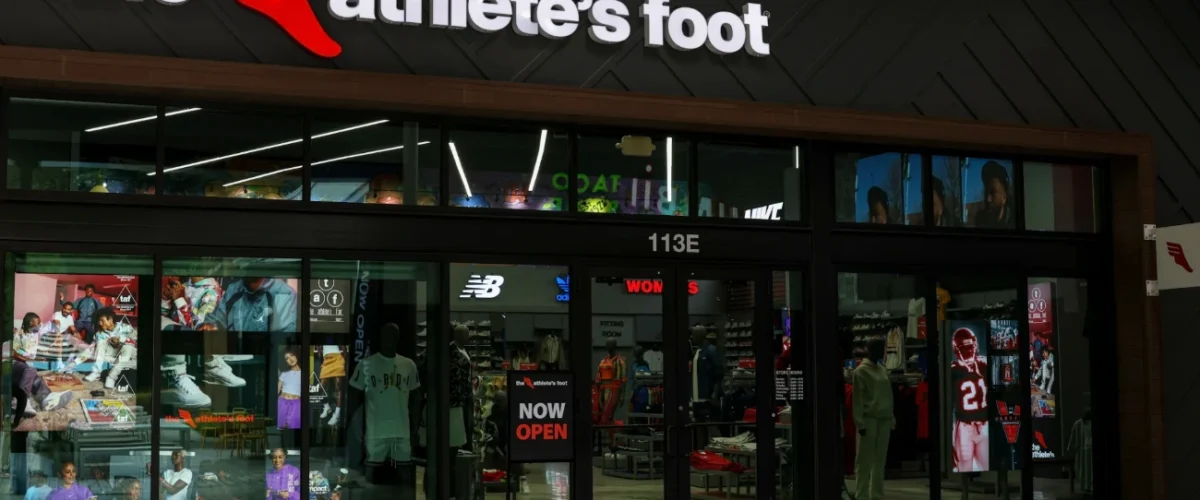
In September 2024, TAF celebrated a new Atlanta flagship, U.S. headquarters and community center near the BeltLine and Piedmont Park. The opening program ran September 12–14. The combination placed shopping, company operations and space intended for public activities within one project.
REBusinessOnline identified the project’s collaborators, including real-estate adviser T. Dallas Smith & Co., general contractor J.M. Lee Construction and mural artist Aysha Pennerman. Those credits make the building’s production part of the record, rather than treating local identity simply as an atmosphere.
The Atlanta Voice subsequently reported the launch of Monroe Mixers at the store on November 8, 2024. The official U.S. directory now lists the Piedmont Park branch at 931 Monroe Drive NE, Suite 113E, Atlanta. It is a current reference point for this chapter, not the original Pittsburgh location.
The Athlete’s Foot’s history therefore extends from specializing in a product category to considering the people, partnerships and ownership arrangements around it. Its most distinctive thread is the relationship between a global retail name and the locally specific work needed to give that name a life on a particular street.
Related store histories
Fleet Feet
Foot Locker
For the wider context, explore Sneaker History and Culture: From Rubber Soles to a Global Movement.