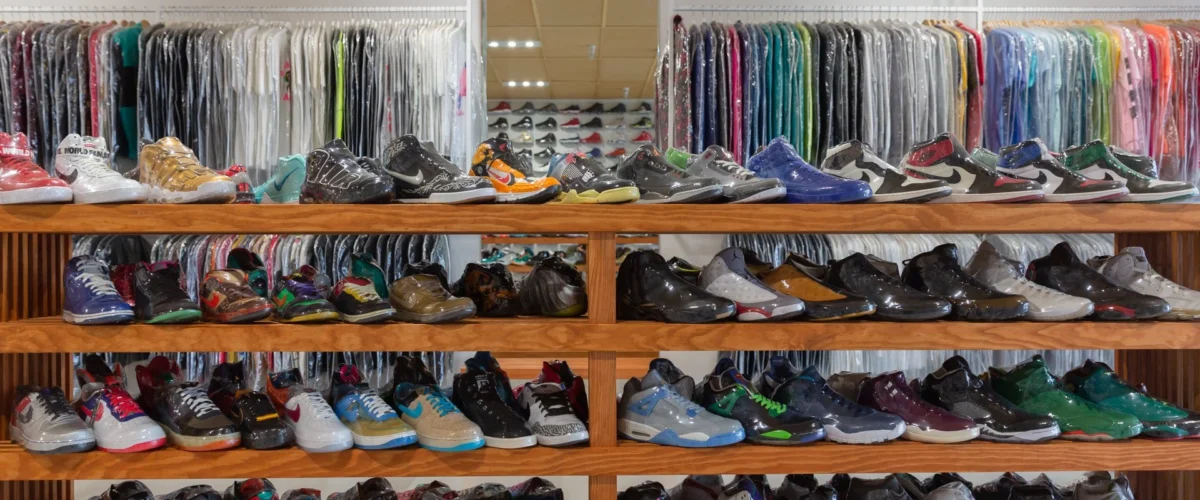
A resale wall can place shoes beside one another that never shared a release calendar. RIF LA becomes interesting at that meeting point between periods: something that disappeared from one store can return through another, with a new owner and a different conversation around it.
RIF’s trajectory is tied to Los Angeles’s Little Tokyo. Its beginnings help illuminate a period when trading collectible pairs depended heavily on specialist shops and the relationships formed around them.
From L.A. Avenue to RIF
Pacific Citizen’s reporting records Ed Mateo and Jeff Malabanan purchasing L.A. Avenue in 2006 and operating it as RIF. The name expressed an ambition to reinforce not only an interest in shoes but also cultures and ideas.
The origin involves continuity: there was an existing business and a connection with Japanese retail. The new owners kept Little Tokyo as a base while adding their own direction.
This differs from the history of a manufacturer or a boutique primarily known for designing collaborations. RIF operates at a later stage in products’ lives, when personal collections and objects from different periods can return to the market.
What consignment changes
Consignment allows an owner to offer an item through a store under agreed terms. In the RIF setting described by the reporting, the model brought together shoes supplied by collectors rather than only recent deliveries from brands.
That changes the discoveries a shop can offer. A visitor might encounter a model they stopped following, an edition previously known only through photographs or a variation they were not actively seeking. The selection depends partly on what re-enters circulation.
This is why a resale shop can resemble an informal archive while remaining a business. Its pairs are not necessarily preserved indefinitely; they change hands. Memory resides in their temporary assembly and in the knowledge needed to distinguish them.
A record of shop culture
RIF’s December 2013 blog archive provides a dated view of that daily life. Posts show Jordan arrivals, references to samples and player exclusives, and photographs of people wearing their pairs. The seventh anniversary appears in the same archive.
Such records preserve more than a sequence of transactions. They retain the language and attention devoted to particular objects at a specific moment. A present-day reader can see that sneaker enthusiasm included watching what other people chose to wear.
The 2013 archive also marks RIF DOS’s first anniversary, recording an extension into a separate apparel-and-accessories operation. That chapter broadens the picture beyond footwear without severing its relationship with collecting.
Little Tokyo supplies the setting
Pacific Citizen placed RIF among other sneaker-related businesses in the neighborhood. Their proximity helps explain how retail, shoe care and gatherings could occupy the same part of the city.
RIF’s cultural interest can be read through that circulation between people, periods and uses. Knowing the store provides a way to see that a sneaker’s history does not end when its official release is over. Another chapter often begins when it appears on a shelf again.
Sources and further reading
Pacific Citizen: The Soles of J-Town
RIF LA: 2013 anniversary records
Related store histories
CoolKicks
Laced Up