Finish Line’s history can be read through the different places where a sneaker becomes desirable: a shop wall, a printed page, a photograph of a musician or a screen. Following those settings reveals the chain’s particular identity and its ways of presenting products. It also helps explain why its changing storefront deserves a history of its own.
Indiana and the mall
The company traces its roots to an Athlete’s Foot franchise opened in Indianapolis in 1976. The first Finish Line-branded store followed in Speedway, Indiana, on July 2, 1982; the remaining franchise stores converted in 1986. Its timeline also dates the first finishline.com sales to 1999, placing online retail within a longer physical-store history.
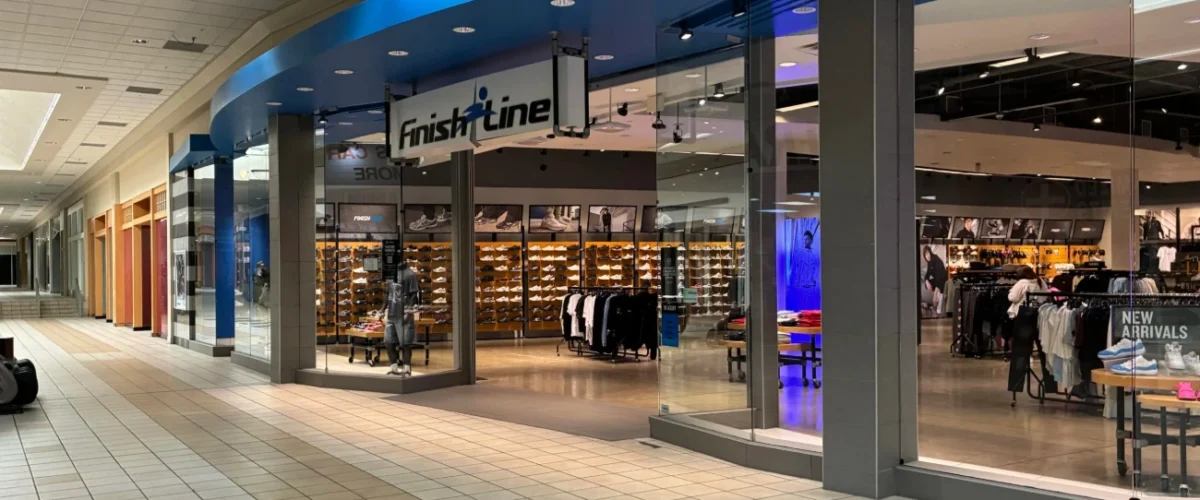
After its June 1992 stock-market debut, the chain expanded to 545 stores by April 2004. That year’s annual filing described larger mall shops and shoe walls arranged by sporting category. The format made comparison a physical activity: basketball, running and casual footwear could be considered within a single store, alongside clothing and accessories.
Finish Line’s 2004 annual filing
Print extended that encounter beyond the mall. According to Finish Line’s retrospective, the first quarterly SPIKE catalog appeared in spring 1997 with Allen Iverson on the cover; the last printed catalogs followed in 2009. Release dates made those pages useful records. They preserve information beyond a shoe’s original selling season.
The history of Finish Line’s catalogs
The shift to screens involved more than replacing paper. The 2013 annual report describes investment in mobile shopping, social media and connected store systems, including handheld checkout equipment. Those details show the practical work behind the digital transition: the brand sought continuity between discovering a product, checking its availability and completing a purchase through different channels.
Inside another retailer
A September 28, 2012 agreement with Macy’s opened a different route to customers. Finish Line would operate branded athletic-shoe departments, with rollout starting in spring 2013, while also supporting Macy’s online offer. The arrangement carried a specialist name into a department store, allowing its selection to meet shoppers beyond the standalone Finish Line network.
The 2017 annual filing clarifies the distinction. Finish Line still had its own mall stores, while Macy’s contained both branded shops staffed by Finish Line and unbranded areas generally served by Macy’s employees. That layered structure matters to the later history: a retail name can remain visible inside another business even as its separate storefront network changes.
Sport also connected the chain to organized participation. Special Olympics’ 2012 annual report documents a national partnership with Finish Line and its Youth Foundation, supporting the TRAIN sports-assessment and nutrition program alongside employee volunteering and customer fundraising. This provides a concrete community chapter, grounded in a named partner and program rather than a broad claim about social impact.
Music enters the frame
In August 2017, Finish Line announced its partnership with Migos. The choice placed contemporary rap at the center of the retailer’s public image and gave the sneaker offering a connection to the group’s style. The partnership connected the presentation of footwear to an artist’s wardrobe and public image, giving the retailer a new set of people and references around which to build campaigns.
A December account explained the collaboration in more detail. Migos contributed creative direction to shoots in Los Angeles and at Quality Control Studios in Atlanta, choosing outfits and images that appeared in stores, online and on Instagram. Here, styling became part of retail authorship: the musicians helped determine how products were presented, rather than simply standing beside a logo.
Corporate ownership changed on June 18, 2018, when the merger with JD Sports was completed. Finish Line became an indirect wholly owned subsidiary. The date marks a change in control, while the American chain’s earlier mall, catalog and department-store histories remain distinct from JD’s British origins.
The customer relationship changed too. Finish Line’s STATUS documentation, effective January 23, 2020, offered a route for Winner’s Circle members to move into the newer program. As a historical document, it captures the transition from one loyalty identity to another and the growing importance of an account that accompanied shopping in stores and on screens.
A transition still in progress
JD’s September 2026 results counted 145 standalone Finish Line stores and 254 Macy’s corners as of August 1. The stated plan was to convert or close the standalone stores by the end of fiscal 2028; Macy’s corners were excluded. This was an announced timetable, with the two formats still coexisting at the reporting date.
September 2026 results and conversion scope
On October 13, 2026, Finish Line’s official directory still listed Great Mall of Milpitas at 402 Great Mall Drive, California, with operating hours. It offers a current physical reference for the profile, subject to the continuing transition. Store naming should be checked again before a visit, because a directory entry is a dated observation of a changing network.
Finish Line at Great Mall of Milpitas
Related store histories
JD Sports
Hibbett
For the wider context, explore Sneaker History and Culture: From Rubber Soles to a Global Movement.