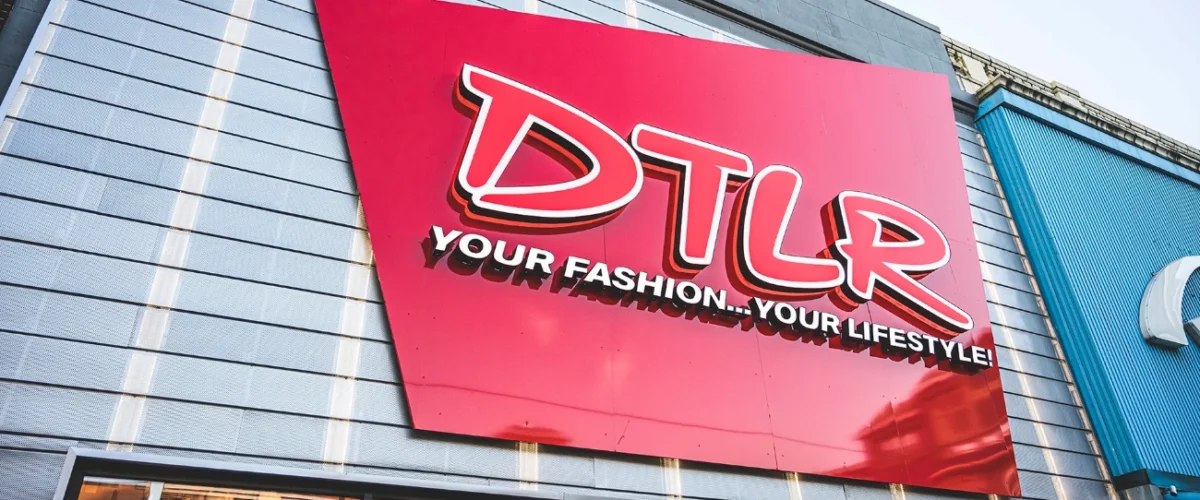
A sneaker retailer can express its identity through more than the shoes on display. Its music, collaborations and public events can offer another kind of introduction. DTLR provides a particularly useful example because those activities leave a documented trail alongside its expansion. Read together, the records describe a business shaped by the conversation between athletic footwear, entertainment and neighborhood audiences, even as ownership and the scale of the company changed.
Maryland roots and a change of emphasis
DTLR’s 2013 securities filing dates its operating company and first Towson, Maryland, store to 1983. It places the shift toward street-inspired fashion in the early 1990s and the addition of music to the merchandise mix in 1999. These dates come from that detailed historical account; other company summaries give different starting years.
The name also records an evolution. Former investor BRS described the business it acquired as Downtown Locker Room, subsequently rebranded DTLR. In its account, a regional Mid-Atlantic operation expanded through additional stores and the VILLA combination. The shorter name traveled with a broader business, while the original wording retained a recognizable connection to athletic retail.
A useful distinction in this history is between scale and character. Expansion can be measured in stores, but that does not explain what makes a banner recognizable. Concrete choices about presentation and communication are more revealing than size alone. DTLR’s later projects offer several different ways to examine that question.
Music as part of the retail medium
DTLR Radio dates its launch to 2013. Its own description connects online broadcasting with playback in stores and a mobile app. Radio gave the business a channel that could reach listeners away from a merchandise display. It also made the store soundtrack part of a named publishing activity, with its own presenters and programming.
One example is the station’s June 2024 interview with singer Lekan. The published introduction describes a discussion of his upbringing, artistic identity and approach to music, accompanied by a live performance. Such material shows a retailer producing artist-led content rather than limiting its public voice to release calendars or product announcements.
The 2023 New Balance 990v3 GR3YSCALE project offered another form of cultural interpretation. DTLR credited June Sanders with its layered gray palette and linked the model to the Washington-area DMV audience as well as runners and enthusiasts of the dad-shoe silhouette. That regional framing belongs to DTLR’s account of the release; it should not be treated as a description of every wearer.
What the VILLA merger brought together
The DTLR and Sneaker VILLA transaction was completed in August 2017. The investors’ contemporary announcement emphasized complementary territories with limited overlap. That matters beyond the arithmetic of expansion: a combined chain can inherit different histories of neighborhood engagement. Those histories deserve to remain visible instead of being retroactively credited to a single original business.
For example, VILLA and Jordan Brand created A’s for J’s in 2013. An April 2017 account, now preserved on DTLR’s site, describes academic rewards and a student outing to Jordan’s Terminal 23 facility. It is evidence of a VILLA-era program before the merger, rather than proof that DTLR itself launched the initiative or that its original terms remain available.
In 2020, DTLR announced a virtual HBCU esports event and career fair with Cxmmunity and 300 Entertainment. Planned for two October dates during pandemic disruptions, the project connected gaming, music and historically Black colleges and universities. It documents a specific response to interrupted campus activities. The announcement establishes the initiative’s intentions, not a measured claim about its eventual educational impact.
A larger group, with local identity still at issue
JD Sports completed its DTLR acquisition on March 17, 2021. In the subsequent interim report, JD said it intended to retain DTLR, Shoe Palace and JD/Finish Line as distinct retail banners, citing their different locations and customer relationships. The statement shows why a regional identity could matter within an international ownership structure.
A later chapter connected DTLR with City Gear. The official Better Together page documents their integration and customer-policy changes taking effect in June 2025. It is another reminder that a familiar storefront name and the organization behind it follow related but different timelines. Historical programs and policies should always be read in their own period.
Towson remains a useful geographical anchor. The official locator listed a DTLR at Towson Town Center, in unit 1070, when checked in October 2026. That confirms a contemporary presence in the city associated with the company’s early history, without establishing that today’s unit occupies the original store’s premises.
DTLR’s distinctive story emerges from these connections: a regional retailer becomes a broadcaster, a collaborator and the custodian of another chain’s projects. Its cultural role is best approached through those specific actions. They reveal how sneaker retail can assemble music, place and commercial identity without requiring a claim that one company represents an entire community.
DTLR’s historical securities filing
Related store histories
Social Status
Shoe Palace
For the wider context, explore Sneaker History and Culture: From Rubber Soles to a Global Movement.