A sneaker can represent a city without borrowing a familiar landmark. Burn Rubber’s Workforce Pack found its reference in working people. That choice lets the boutique’s story begin with a human relationship, before considering colors or logos.
Burn Rubber belongs to the cultural story of Detroit, although the shop’s roots are in Royal Oak, a separate city in the metropolitan area. Keeping that distinction makes the history more precise. Its identity developed through relationships between a small store, an industrial region and people using footwear to express their interests.
An existing shop enters a new chapter
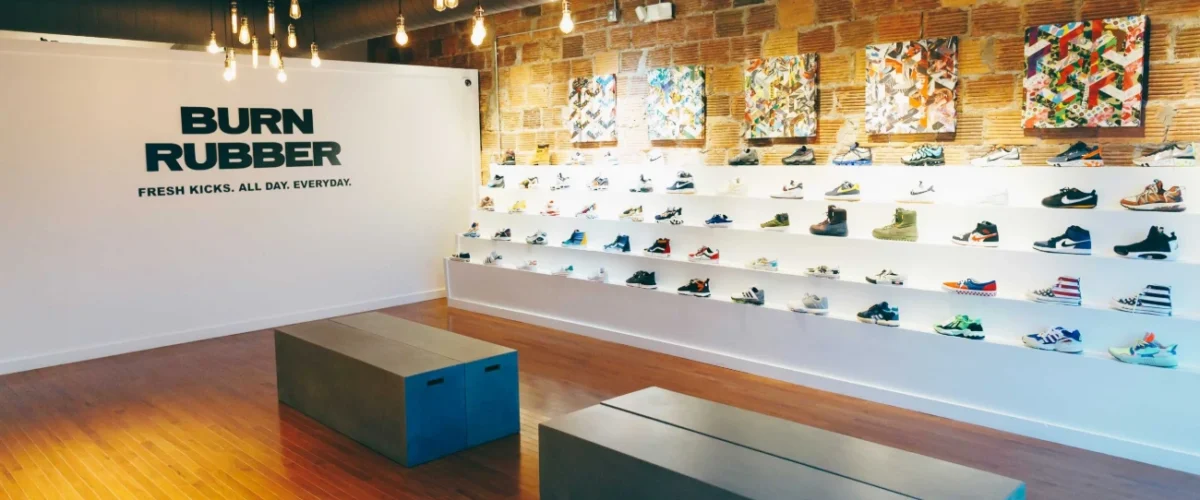
The business began in 2004. According to Burn Rubber’s official history, Rick Williams and Roland Coit took ownership in 2007. The shop they reorganized measured just 680 square feet. Those dates describe different events: the pair did not establish the original business, but they gave it a new direction.
Coit, known in music as Ro Spit, and Williams brought their own creative backgrounds to the enterprise. The small footprint helps explain the challenge without requiring an invented scene behind the counter. A tightly edited selection had to communicate a recognizable personality. The people running the store became part of what customers associated with its name.
Music entered through the front door
In an interview with Detroit Is It, Coit recalled playing his music in the shop and finding new listeners among its customers. People began visiting partly because of their connection with the owners. Retail and music stopped operating as entirely separate parts of his life.
That detail says more about Burn Rubber’s cultural role than a list of celebrity visitors. Customers were meeting people with their own work and taste, rather than anonymous intermediaries for larger labels. Wearing something bearing the shop’s name could express an attachment to that wider creative environment.
Coit’s later work included Two18. It is a connected chapter, but the names should remain distinct: a Two18 collaboration is not automatically a Burn Rubber release. Shared people and a shared regional context do not make the two retail identities interchangeable.
Workforce starts with people close to home
The 2012 New Balance MT580 project paired Blue Collar and White Collar editions. According to the explanation reproduced by Nice Kicks, it honored automotive workers affected by the downturn.
That starting point changes how the shoes read. This was not simply industrial styling or a convenient reference to Motor City. There was an emotional relationship between the designers and the people represented. The collaboration gave a local experience a physical form that could circulate far beyond Michigan.
It also offers a way into collecting that does not begin with resale prices. Understanding the story makes the paired editions more meaningful, whether a reader owns either shoe or merely encounters an archival photograph. A release can be interesting because of what it chooses to remember.
Personal memories become creative material
In a separate Sneaker Freaker interview, Williams and Coit discussed their Reebok Ventilator collaboration through childhood memories. The same conversation described the store as a place where people interested in sneakers could meet. Their account makes the idea of community specific: people who already shared an interest gained somewhere to recognize one another.
Burn Rubber’s most compelling scale is therefore a human one. Work, music and memory were not unrelated themes attached to products for variety. They came from the experiences of the people behind the shop. Following those connections produces a richer history than listing launches in date order. The sneakers become objects through which the Detroit area tells stories about itself.
Sources and further reading
Nice Kicks: New Balance Workforce Pack, 2012
Sneaker Freaker: the creators explain the Ventilator
Detroit Is It: Roland Coit, music and retail
Related store histories
Xhibition
Corporate
For the wider context, explore Sneaker History and Culture: From Rubber Soles to a Global Movement.